Life at Light Hall Sixth Form

Your Timetable

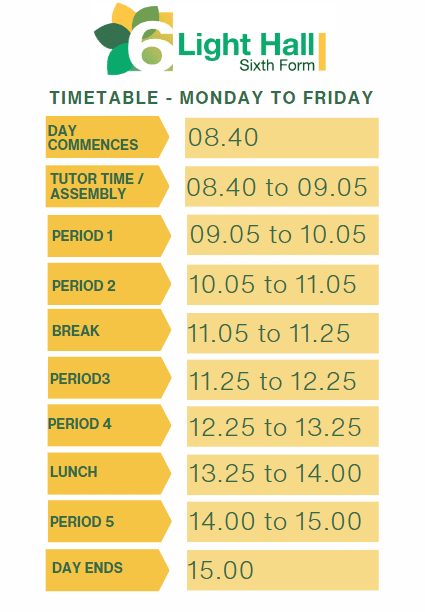
Sixth Formers follow the same timetable as the rest of the school, starting with form time at 8.40 am and leaving at 3 pm. Students have 5 sessions a day, consisting of a combination of teacher-led subject lessons, independent study, enrichment activities or the Extended Project Qualification sessions.

Year 13 students are expected to be in school periods 1-4, but may earn the privilege of leaving to study at home at 2 pm on a day when they have an independent study session, period 5. 

Sixth Form students have two breaks throughout the day where they can buy food and drinks from the Sixth Form Centre and spend time with their friends.

The school day ends at 3 pm, but students may choose to make the most of after-school extra-curricular activities

Your Facilities

Sixth Form Café

Year 12 and 13 students have special access to the Sixth Form food and drink offer. A menu full of hot and cold snacks, lunches and drinks. Served between 10 am and 2 pm, students have the freedom to plan their meal times to suit them. 

We also have vending machines stocked with all the snack essentials, iced coffees, hot drinks and free hot water. 

Study and Social Spaces

At Light Hall Sixth Form, we have several spaces for independent study, each suited for different types of learning. We understand the importance of an appropriate learning environment to support students in achieving success. Some of our key spaces include:

  • Group Study Rooms – great for group revision, project work or just some silent independent work. Students may also make use of the large whiteboards for testing and revision.
  • Focussed Study – This large study space offers several charging stations and is for silent study. Great for those moments of complete focus and where deadlines are met!
  • Main Study Area – Another great study space during lessons and a place for socialising and refreshment during break times.
  • Classrooms designed for interactive learning – fully-kitted science labs, design technology suites and spaces to fuel creativity in our Art rooms. Students make use of our established yet modern facilities around the School.
  • Quiet Classrooms – students may work quietly with members of staff, where possible, if they want some extra support or a quiet environment.
  • The Library – students can use the computers and resources available to all students.
  • The Hive – students with additional education needs may work in the Hive during their Study Periods for a calm working environment and access to their Learning Support Assistant.

Laptops and BYOD

We’re pleased to offer all Sixth Form students easy access to school laptops. Students may use these laptops in the Sixth Form Area, at home on a long-term loan, or in lessons to support coursework and assessments.

Students also have access to two printers in the Sixth Form Centre and one in the library.

Alternatively, students may choose to work from their own device. There are charging stations throughout the study spaces, and students can connect them to the printer too (limitations apply)!

Whilst students are widely trusted to use their devices responsibly, we may implement periods of device (Phone) use limits to support healthy screen time habits and to maximise the effectiveness of Study+ sessions.

Your Dress Code

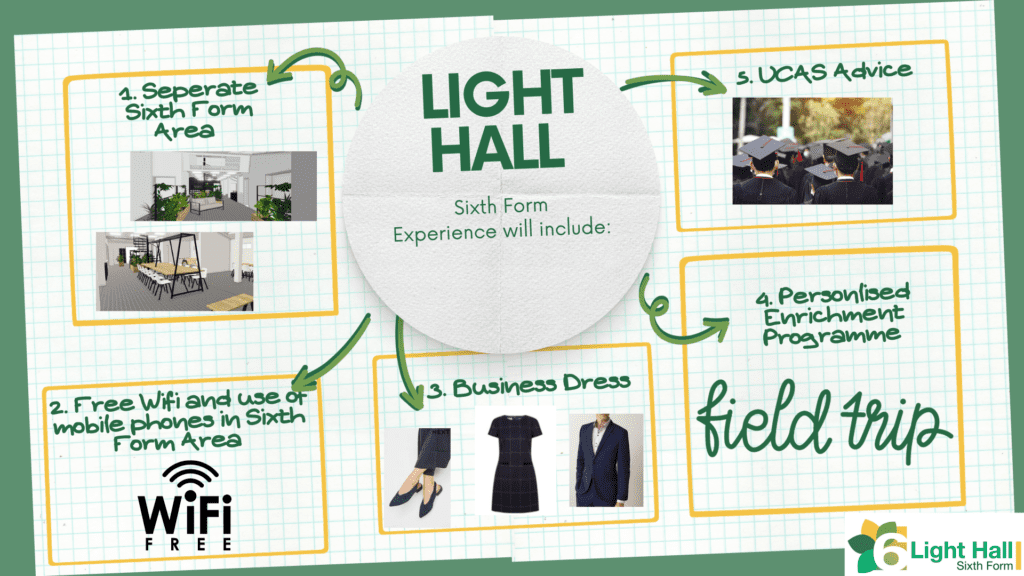
At Sixth Form, we aim to maintain a smart, professional appearance while allowing students to express their individuality. Our dress code strikes a balance between personal choice and the expectations of a formal academic environment. The picture below provides a clear guide to help students make appropriate clothing choices for the school day.

Beyond the Curriculum

As well as their programme of study, students will choose to study either an additional A-Level (Further Maths or Chinese), the EPQ or to follow the enrichment programme. Students may also use this time to carry out leadership duties or take part in the Student Scholar programme, supporting students in the lower school. This allows students to build skills beyond their studies and discover new interests.

As students reach the Spring Term of Year 13, they may opt to use these sessions for additional revision. Thus, these sessions may be used flexibly, in agreement with staff and the Head of Sixth Form.

Enrichment

Students following the enrichment programme will take part in a range of activities, from cooking and baking, 3D printing, debating and sports. The timetable of activities alternates frequently to ensure students experience each activity. Take a look at some key moments form the programme so far!

Extended Project Qualification (EPQ)

What is an EPQ?


The Extended Project Qualification offers students the opportunity to explore a topic or question that is of personal interest. It is widely accepted by all universities, as it demonstrates a commitment to independent learning and research. The EPQ carries up to 70 additional UCAS points and is equivalent to half an A-Level.

Often, universities will provide reduced offers for students with a B or higher in the EPQ. For example, a course asking for ABB would ask students with a grade B in the EPQ to achieve BBB in three A-Levels instead.

Some topics that students have studied previously include the positive impact of boxing on contemporary NHS patients, the root causes of WW1 and WW2, head injuries in rugby and the rule changes needed to prevent them, migration of Homesapiens out of sub-Saharan Africa and issues surrounding allergy management in the UK. Many areas of interest stem from students’ personal experiences and passions, and the EPQ offers students structured time and support to develop their understanding.

The EPQ is supported by a series of academic study lessons. Delivered by our teachers, students will cover topics including: academic writing, research, evaluating the validity and authenticity of results, creating a bibliography, studying and presenting. These skills will help students with their EPQ, A-Level studies and beyond, which is why the qualification is recognised by so many universities and colleges.

Discovering a new interest

Previous A-Level students have found that researching and writing their EPQ has helped them discover a topic they’re really passionate about and helps guide them when deciding what they want to do after Sixth Form.

Extra-curricular Activities

In addition to our academic and enrichment offerings, there are many extra-curricular opportunities available to sixth form students, including:

  • University events, trips, visits, interviews
  • Work experience
  • Sporting activities
  • Outdoor education, including working towards the Duke of Edinburgh Awards
  • Mentoring younger students
  • Young Enterprise
  • Shirley Lions
  • Volunteering opportunities
  • Student leadership roles
  • Optional workshops throughout the year

These activities are designed to complement academic learning and provide students with valuable skills and experiences.

Why do we offer these activities?

Extra-curricular activities not only enhance students’ curriculum vitae and university applications but also play a key role in developing their confidence and transferable skills for the future workforce. While academic studies are important, taking time to focus on non-academic pursuits helps students become well-rounded individuals. These activities offer a valuable opportunity to build skills that will serve students in their future careers and beyond.

Sixth Form Life Ready Programme 2024-2025

Contact Us

For queries related to specific subjects, please contact the relevant Subject Lead. Their details can be found in the A Level Subjects section here.

For any other Sixth Form-related inquiries, feel free to reach out to our Sixth Form team at:

Report a Concern